Maybe you have worked as a labourer on a civil crew and watched the operators all day thinking, I could do that. Maybe you are in a different trade altogether and want a change. Either way, you want to know how people actually get from where you are to the seat of an excavator.
The ticket takes 2 to 4 days. The hours take longer, and that is the part most guides skip. This guide covers the excavator ticket (RIIMPO320F), how long the training takes, the add-on tickets worth having, how new operators land their first excavator operator job, and where the career can take you.
What does an excavator operator do?
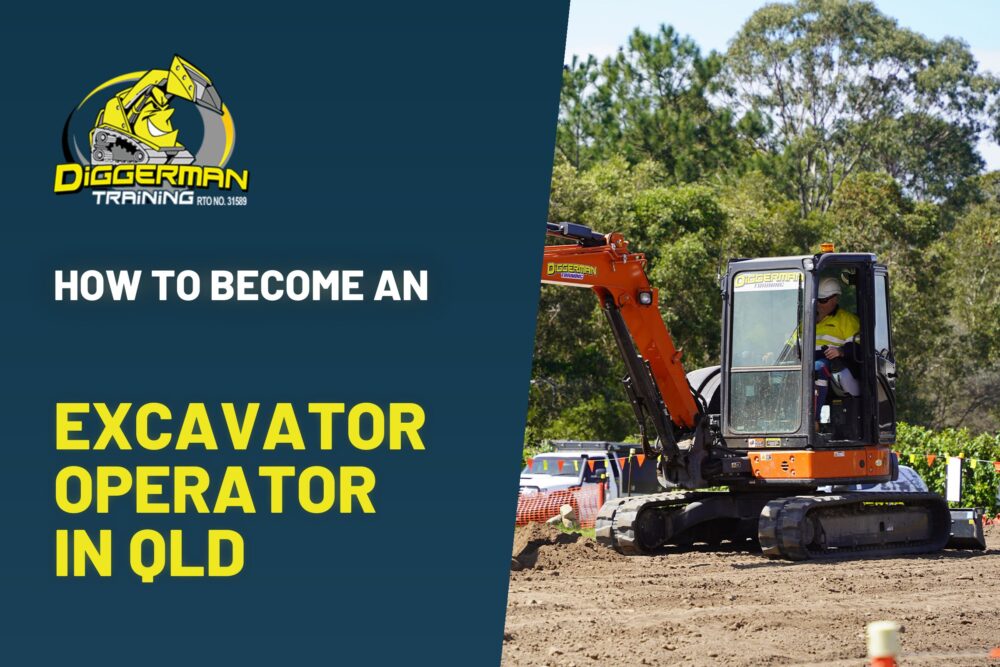
An excavator operator runs the machine that digs, trenches, loads and shapes the ground on a job. You will find them on civil construction projects, roadworks, subdivisions, pipelines, quarries, mines and farms.
The work is more than moving dirt. A good operator plans the job, does the pre-start checks on the machine, digs to the right depth, lifts and places materials, swaps attachments like buckets and rock breaking hammers, and works safely around the crew on the ground.
The RIIMPO320F unit covers exactly that: planning and preparing, pre-operational checks, operating the excavator, lifting, carrying and placing materials, selecting and fitting attachments, relocating the machine, operator maintenance and cleaning up.
Do you need a licence to operate an excavator in QLD?
Since 1 January 2012, excavators have not needed a government-issued licence in Queensland, under the nationally harmonised work health and safety laws. Instead, the business you work for has a duty to make sure you are competent to operate the machine.
That is why employers ask for a ticket. In civil construction, “excavator ticket” or “excavator licence” usually means a statement of attainment for RIIMPO320F – Conduct civil construction excavator operations. It is nationally recognised, and it shows an employer you have been trained and assessed by a registered training organisation. Many sites will also ask you to do a verification of competency (VOC) on their own equipment before you start. You can read more on our verification of competency page.
The tickets you need to become an excavator operator
You do not need a stack of qualifications to get started. Here is what most new operators line up.
1. White card
You cannot work on a construction site in Australia without a white card. The course is CPCCWHS1001 – Prepare to work safely in the construction industry, and it takes one day. If you do not have one yet, book it first or alongside your machine training. See our white card course.
2. Excavator ticket
This is the main one. There are no prerequisites for the excavator training course, other than the minimum age of 15, so you can start with no machine experience. Training is split into theory first, then practical, where you learn how to operate an excavator on a real machine. You are assessed on both. When you pass, you get a statement of attainment and a wallet card. Full details are on our excavator ticket course page.
3. Useful add-on tickets
One machine gets you started. A few machines make you easier to hire, because a small crew wants someone who can jump between them. Good add-ons for a new excavator operator include:
- Skid steer loader (RIIMPO318F). Common on residential and landscaping jobs, often working alongside a small excavator. Skid steer and bobcat course.
- Front end loader (RIIMPO321F). Loading trucks, stockpiling and moving material on bigger sites. Front end loader course.
- Roller (RIIMPO317F). Compaction work on roads and pads. Roller ticket course.
If you plan to do three or five machines, ask about our machinery bundles.
How long does excavator training take?
The excavator course runs over 2 to 4 days at Diggerman Training. How long you need depends on your experience. Someone who has already spent time on a digger may finish sooner. Someone starting from scratch gets more seat time.
Theory runs on Monday mornings at 7.30am, and online theory is available if you cannot make it on a Monday. Practicals run Monday to Saturday from 7.30am, plus 4pm sessions on Wednesdays and Thursdays. Courses run every week, so there is usually a start date coming up. Check the excavator course dates for the current day and night options and current pricing.
If you already work in Queensland construction, you may be eligible for CSQ funding. Check the eligibility rules on the CSQ website or ask us when you enquire.
Training in Townsville
You do not have to travel to the Sunshine Coast. Our trainer in Townsville runs the excavator course there too. Townsville courses are booked by enquiry for now, so head to our Townsville page to get in touch and sort out dates.
How to get your first excavator operator job
A ticket gets you in the door, but hours in the seat get you hired. Employers putting someone on a big excavator next to a live trench want to know you have done it before. That is why so many excavator operator jobs ask for experienced operators.
So how do you build hours when every job wants experience? Here is what works for a lot of new operators.
- Start on the machines with a lower experience barrier. Roller and articulated haul truck tickets do not carry the same experience barrier as the excavator. You do not need a great deal of experience on these machines to get onto a site and start working. Once you are on a crew, ask for time on the excavator.
- Take a labouring or trade assistant role on a civil crew. You learn how a site runs and the crew gets to know you. When an operator is off, you are first in line.
- Look at smaller operators. Local earthmoving, landscaping and plumbing businesses often run small excavators and may be more willing to train someone up.
- Keep a log of your hours. Note the machine, its size, the work you did and when. A written log makes your resume stronger and helps when an employer runs a VOC.
- Stack your tickets. Two or three machines on your card shows you are serious and makes you more useful to a small crew.
Ella came to us nervous and wanting a career change. She started on haul trucks, one of those lower-barrier machines, and when she wrote to us she had landed a job as a new-to-industry operator on trucks carrying up to 240 tonnes. Different machine, same pathway: the right tickets first, then hours on site.
Excavator operator pay in Australia
We do not set wages, and pay varies a lot by region, employer, machine size and whether you work FIFO or local. The best independent figure we can point to is from Jobs and Skills Australia. Earthmoving plant operators, which includes excavator operators, earn a median of $1,900 a week before tax in full-time work, based on ABS data from May 2025. See the Jobs and Skills Australia earthmoving plant operators profile for the details.
Treat that as a national guide, not a promise. A new operator will usually start below the median and move up as their hours and tickets grow.
Where an excavator ticket can take you
The excavator is often the first big machine people learn, not the last. Once you have hours on it, there are clear next steps.
More plant
Add a bulldozer ticket, a front end loader or an articulated haul truck and you can move between machines on a bigger civil job, a quarry or a mine site.
GPS and 3D machine control
GPS machine control is a skill worth adding. Our GPS 3D Trimble Earthworks course is a 4 to 6 hour non-accredited course for operators who already hold RIIMPO320F. It covers site tasks like road boxing, footpath prep, cutting and shaping batters, trenching and V drains. You come away with a VOC and a statement of attendance.
Grader
The grader is a specialist machine and a common goal for experienced operators. The grader ticket course (RIIMPO324F) runs over 2 to 4 days. There are no prerequisites, other than the minimum age of 16.
What our machine students say
“Cant recommended these guys enough! Ladies in the office are super friendly and helpful. I am currently in the process of completing my last of 3 machinery tickets, excavator, roller and skid steer. The guys out the back paddock that train you, Trevor, Max, Steelo and Ned are knowledgeable and helpful. The easy going vibe and relaxed atmosphere makes learning easier as the stress is taken out of it. Safety is important and teaching you the right way the first time is clearly important to them. You’ll have a great day with some laughs and walk away with the skills and confidence to go on with what you’ve learnt. All the machinery is well maintained and in good order. Facilities are fantastic as well. Highly recommend 👌” – Nichole, excavator, roller and skid steer
“I’d like to personally thank your team at Diggerman Training. I participated in a Excavator course last week and I really enjoyed the format of how it was conducted. The first reservation that was addressed by your trainer staff was to welcome us as new prospects, this removed the anxiety and awkwardness of being new to this Industry sector. Secondly, the detail that was expressed during the written assessment of the course, Diggerman Staff were on the pulse with guiding our group. The following 2 days of practical examination was tailored in such a way, whereby the staff would allow us the freedom to operate the machinery safely and apply technical advice when we required it. …” – Xaler, excavator course
“When I first parked out the front of Diggerman Training I was a super nervous young woman wanting a career change. … Now I have my dream job as a New to Industry Operator driving haul trucks which carry up to 240 tonne, thanks to the boys at Diggerman.” – Ella, career change into civil
Key takeaways
- To become an excavator operator, start with a white card and the RIIMPO320F excavator ticket.
- The excavator course takes 2 to 4 days, with no prerequisites.
- Add skid steer, loader or roller tickets to make yourself easier to hire.
- Build your hours on site. Machines with a lower experience barrier, like rollers and haul trucks, are a common way in.
- Once you have hours, GPS 3D machine control, more plant and the grader are the next steps.
Courses mentioned in this article:
- CPCCWHS1001 – Prepare to work safely in the construction industry
- RIIMPO320F – Conduct civil construction excavator operations
- RIIMPO318F – Conduct civil construction skid steer loader operations
- RIIMPO321F – Conduct civil construction wheeled front end loader operations
- RIIMPO317F – Conduct roller operations
- RIIMPO323E – Conduct civil construction dozer operations
- RIIMPO337E – Conduct articulated haul truck operations
- RIIMPO324F – Conduct civil construction grader operations
- GPS 3D Trimble Earthworks course (non-accredited)
Ready to start your excavator operator career?
The first step is a start date. Pick one from the excavator course dates and add a white card if you do not have one. Not sure which tickets to stack for the jobs you are after? Call us on (07) 5351 1811, or 07 4439 5162 for Townsville, and our team will help you work out the right mix.
Frequently asked questions
Q: Can I become an excavator operator with no experience?
Yes. There are no prerequisites for the excavator course, other than the minimum age of 15, and our trainers teach complete beginners. Getting your first operator job usually takes some time on site as well, so plan to build your hours.
Q: How long does it take to get an excavator ticket?
The course runs over 2 to 4 days at Diggerman Training, depending on your experience. Theory comes first, then the practical. You are assessed on both.
Q: Is an excavator ticket the same as a licence?
Not quite. In Queensland, excavators have not needed a government-issued licence since 2012. The ticket is a nationally recognised statement of attainment for RIIMPO320F, and it is what employers ask to see.
Q: Can I do excavator training online?
You can do the theory online if you cannot make the Monday morning session. The practical and assessment happen on a real machine at our Coolum training facility or in Townsville.
Q: Can an excavator ticket lead to FIFO work?
It can be a first step. Most operators build their hours on civil jobs before they go after FIFO roles, because employers on remote sites look for people who have already proven themselves in the seat.
Q: What should I wear to the course?
A long-sleeve hi-vis shirt (or a long-sleeve shirt with a hi-vis vest), long pants and steel cap safety boots. A hard hat and safety glasses are optional.